


| << Prev || עברית || Français || Русский || Next >> |
Appendices
The Oslo Report: How much does the Oslo process really cost us? (2/4)
Components of the economic price (1/3)
Transfer of funds to the "Palestinian Authority" created by the Oslo Accords
The PA budget relies on unprecedented foreign aid in relation to the size of the population[75]. This assistance is mainly used for massive over-employment in the various PA security organizations[76]. In other words, Israel and the world pay huge sums every year to leave the very large number of arms carriers in the PA satisfied and pleased so that they will not engage in terrorism. This ongoing international bribery is called "maintaining stability", and Israel's share of it is $ 1.2 billion a year[77], or NIS 88 billion so far, and an additional NIS 4.2 billion each year[78].
The additional cost of GSS activity in territories transferred to "Palestinians"
Secret service budgets are confidential data. Until 2004, the GSS budget was hidden between budget items, where it was on the same item as the Mossad budget. This item has grown in real terms every year. In 1997 it was estimated at NIS 2.45 billion[79], in 1998 it was NIS 2.7 billion[80], in 2004 it was NIS 3.75 billion[81], and in 2012 it was NIS 6 billion[82]. In an attempt to assess the distribution of this budget between the GSS and the Mossad, we examined the costs in "similar" countries, and apparently the ratio is approximately 2: 1 between the Mossad and the GSS security service, meaning that the GSS budget is approximately NIS 4 billion per year.
Until the Six-Day War, the GSS was a very small organization. The treatment of the "Palestinian" population has since increased its size and this is its main effort. In principle, the division of intelligence work in Israel is as follows:
The GSS is responsible for the area controlled by the IDF.
Military Intelligence is responsible for the area beyond the control of the IDF.
The Mossad is responsible everything beyond that; i.e., in the heart of neighboring countries and the rest of the world.
The division into secret police, military intelligence, and foreign intelligence is also accepted worldwide. But the Oslo process created an anomaly in this division, because a situation was created in which most of the terror comes from areas that are in direct contact with Israel, but are no longer under the control of the IDF, which allows the GSS to operate efficiently in the area.
A situation has arisen in which Israel must thwart terrorism in a large and crowded area that is connected to it, but without controlling it. In addition, the transfer of control of the territory to the terrorists enabled it to liquidate an extensive human intelligence infrastructure that the GSS had set up in the field with great effort during the 26 years preceding Oslo, most of which was destroyed. Anyone who thinks otherwise is invited to recall the headlines since then about the murder of hundreds of collaborators, and the flight of hundreds of them to Israel[83], and the wave of terrorism which followed.
The GSS is forced to "control" the area in terms of intelligence, but from the outside. It is true that Military Intelligence and the Mossad collect intelligence from the outside, but their missions are very different in terms of the human scope in question and the immediate proximity of the danger.
The Oslo agreement was signed in 1993. Since 1997, in other words, since the mire of suicide terrorism that followed Oslo, and until 2004, the GSS budget has risen by more than half. This increase in the budget occurred even before the total withdrawal from the Gaza Strip a year later, which created serious and new problems. Overall, it is reasonable to assume that the GSS budget had to grow about four times what it was before Oslo, and then stabilized at its new high level, which provides a response to the enormous intelligence difficulty that has been created. This amounts to a cumulative addition of approximately NIS 37 billion, plus approximately NIS 2 billion each year.
The additional cost of IDF activity
The IDF has invested an enormous portion[84] of its ongoing activities in the territories of Judea, Samaria and Gaza, as well as in the "seam zone" and in the "Gaza envelope", since Israel has given extensive territory to the "Palestinians". The IDF and the Border Police operated there even before Oslo, but since Oslo, the difficulty and the cost have increased significantly, because the IDF and the Border Police are no longer in control.
The result of the Oslo process was a tremendous increase in terror. The number of those killed, on a multi-year average, jumped threefold, and thousands of rockets fired at increasing ranges dwarfed the Katyusha phenomenon of the past. Israel has invested tremendous effort in thwarting terrorism despite the great difficulty that Oslo has created, but sometimes things simply become intolerable, and the Israeli government decided during those times on exceptional military operations against terrorism, which received exceptional funding.
Below are details of the operations and the unplanned addition to the defense budget during those years:
Operation "Defensive Shield" in Judea and Samaria (2002) ‐ NIS 8.6 billion.
And in the Gaza Strip:
Operation "Rainbow in the Cloud" (May 2004) and Operation "Days of Repentance" (October 2004) ‐ NIS 4.2 billion.
Operation "Summer Rains" (Summer 2006) began following the kidnapping of soldier Gilad Shalit and lasted for five months at various levels of intensity, during which the Second Lebanon War also occurred ‐ NIS 11.5 billion.
Operation "Warm Winter" (February 2008) ‐ NIS 5.5 billion.
Operation "Cast Lead" (January 2009) lasted 22 days ‐ NIS 9.5 billion.
Operation "Pillar of Cloud" (November 2012), which lasted 8 days, did not include ground entry into Gaza, but did include massive air activity, reserve mobilization, and rocket fire that reached Tel Aviv and Jerusalem ‐ NIS 9.5 billion.
In addition, in the year in which the disengagement from Gush Katif was implemented, the defense budget was increased to over NIS 7 billion.
These amounts are included in the total expenditure of the Ministry of Defense, which, according to Ministry of Finance data, increased from NIS 19 billion to NIS 60 billion in nominal values between 1993 and 2012, and in real values from NIS 40 billion to NIS 60 billion[85]. Below is a diagram showing the dramatic increase in the Ministry of Defense budget, in real values (adjusting the value of money to inflation). In the years when the defense budget was supposed to decline, due to the "outbreak of peace" in our region and the continued weakening of the neighboring countries, the relative share of the budget rose. Security from the state budget from 15% to 20%, and in certain years to 22%.
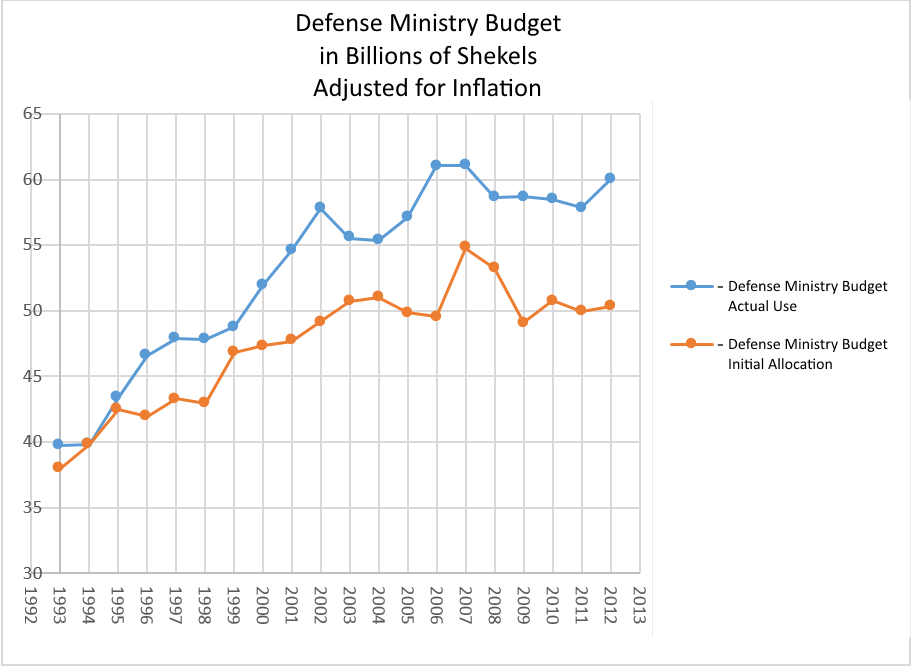
Despite the ongoing cuts in the salaries of those serving in the IDF, which is a major component of the defense budget, as well as a deep cut in IDF training in the regular army and reserves, whose cumulative "qualitative" result was seen in the Second Lebanon War, the Defense Ministry budget actually increased significantly. The reason for this is the need to continue to defend against the "Palestinians" in the costly manner of external defense. Until Oslo, the "Palestinians" had to make do with the terror of knives and stones, which had largely been suppressed before Oslo. Since Oslo, the suicide bomber's belt has replaced the knife, and the rocket has replaced the stone. These are measures that could be used here before, because Israel ruled throughout the area, and did not have to defend itself from the outside. The areas that were handed over to the "Palestinian Authority" have become reservoirs of weapons and ammunition, and the main point of departure for terrorist activities. After the evacuation of the residents of Gush Katif and the abandonment of the entire Gaza Strip and its border with Egypt, the area became a weapons depot that threatens the southern part of the State of Israel and, more recently, the Dan region. In this context, it is important to mention the "Iron Dome", which is an impressive technological development, but expensive[86]. The price of "Iron Dome", about $900 million, is paid mostly by the US[87], but at a heavy political cost. The cumulative increase in the defense budget in these years is NIS 300 billion adjusted for inflation, and another NIS 20 billion per year.
[75] Wikipedia – The Economy of the Palestinian Authority.
[76] Wikipedia – The Palestinian Authority, the security apparatuses.
[77] The Marker 21 September 2011.
[78] At a rate of NIS 3.5 = $ 1.
[79] Globes 8 January 1997.
[80] Globes 4 January 1998.
[81] Walla 21 November 2004.
[82] Haaretz 3 June 2013, The Marker 3 March 2013
[83] This is how the head of the General Security Service (GSS), Yaakov Perry, describes it in his book, "One Who Comes to Kill You" (1999), p. 259: "The GSS was forced to reorganize in preparation for the evacuation of the IDF from the Gaza Strip. It was a tremendous task. We needed to prepare an intelligence infrastructure suited to the new circumstances in the field ... We also did not ignore our duty to care for those residents who were exposed as collaborators with us. Many of them tied their fate to us many years ago. Quite a few have worked with us since the Six-Day War. In advance of the evacuation, we informed each of them that he was being given the opportunity to leave the Gaza Strip with his family and relocate them in Israel. We promised an Israeli identity card to anyone who decided to move to Israel. ... The sums we paid the agents were very low in Israeli terms, but they were enough to support a large family in Gaza. ... As the date of the evacuation drew near, the supporters feared, and rightly so, what they could expect when the Palestinian Authority took over. When the PA entered Gaza, we asked them not to harm the collaborators who remained there. We reminded them that refraining from harming the collaborators is anchored in an agreement with the PA. But ... some of the collaborators ... were murdered, tortured, their homes burned, their property nationalized." (Page 260): "When the Relocation Administration was established, it included a list of assistants who needed to handle 1400 names. 1200 of them were GSS collaborators."
[84] Brig. Gen. Yigal Slovik, Chief Armored Corps Officer: "You saw the armored personnel carriers who are interested in what intention they have on the rifle, because 11 months a year they were engaged in arrests in Judea and Samaria and not in training on the tank." Walla 28 July 2012.
[85] The data are collected from an open budget site.
[86] Ynet 13 May 2013. Even after the reduction in cost of the interceptor missile, this is a huge gap between the incoming rocket and the interceptor missile.
| << Prev || עברית || Français || Русский || Next >> |