


| << Prev || עברית || Français || Русский || Next >> |
Appendices
The Oslo Report: How much does the Oslo process really cost us? (3/4)
Components of the economic price (2/3)
The additional cost of the Ministry of Internal Security, and damage to car thefts
The Israeli police bear the heavy burden of protecting internal security. Since the Oslo Accords, personal security has been severely undermined, even though the Ministry of Internal Security and the Israel Police subordinate to it have grown much more. The phenomenon of theft of vehicles and agricultural equipment has become a national plague, with the burden falling on the citizens of the state in the form of inflated insurance costs. The Israel Police are primarily concerned with security, and providing a "sense of security," and is barely managing resources to deal with crime, theft, burglary, and the like. With the exception of car thefts (which we will discuss below), it is difficult to calculate these losses, but the increase in the Ministry of Internal Security's budget can be seen clearly. In 1993, the Ministry's actual budget, adjusted for inflation, was NIS 3.5 billion (NIS 1.6 billion in nominal terms). In 1999, the budget jumped to NIS 6.4 billion, and in 2012 it reached NIS 11.5 billion[88]. This means that during the 20 years of Oslo, the ministry's budget in real terms tripled. The cumulative addition to the Ministry of Internal Security's budget is approximately NIS 85 billion.
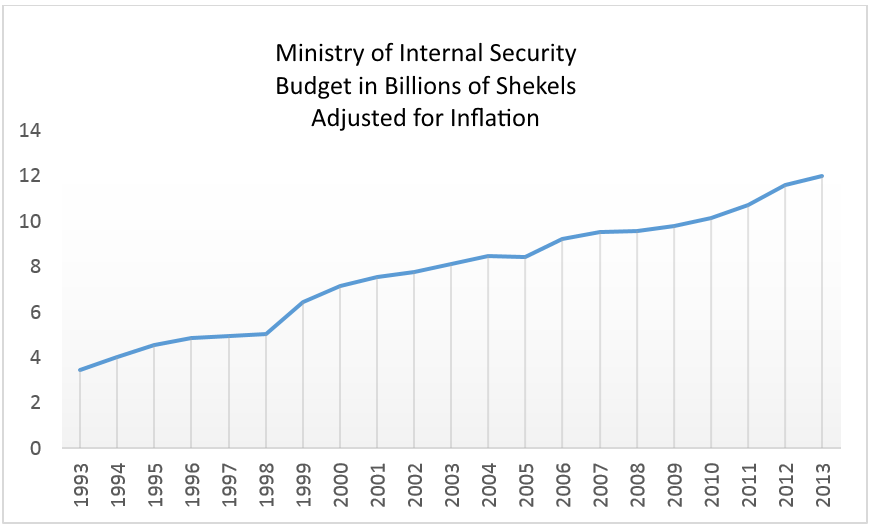
This amount does not include the damage caused to the citizens of the State of Israel due to the crime that has risen greatly in these years. One phenomenon that has been engraved in our memory as it relates to the Oslo Accords is the phenomenon of car thefts, and we will therefore analyze it separately in this section.
Car thefts:
After the Oslo Accords, car thefts became a plague. The unbearable ease with which it is possible to steal a vehicle and within a short time to move to the area of the Palestinian Authority, where the thieves are out of the reach of the police, has encouraged this criminal branch. In 1998, the Israel Police was forced to establish a special unit called Etgar to deal with this problem[89]. As can be seen in the graph below[90], in 1997 the amount of vehicle theft jumped to more than 45,000 vehicles a year.
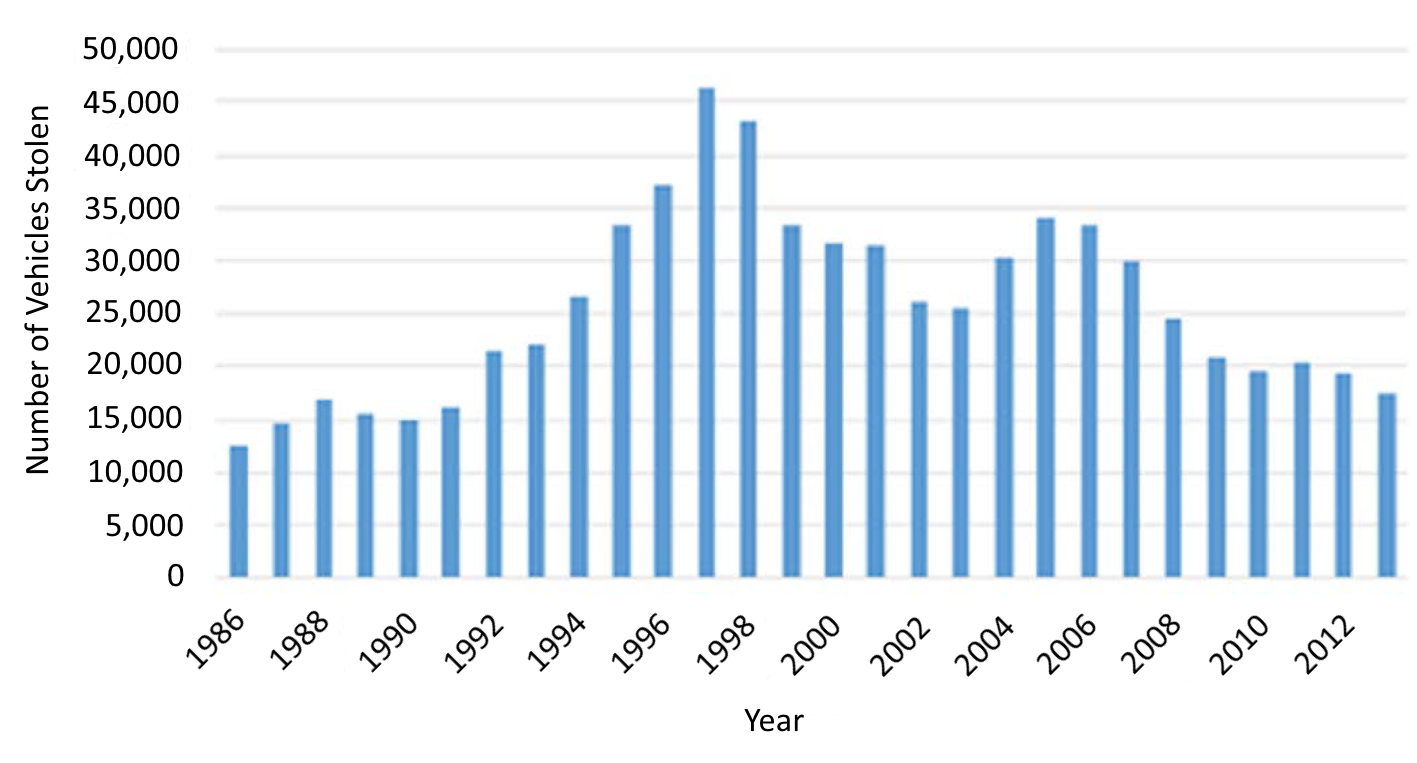
After the vehicles thefts were reduced to a "reasonable amount", the Etgar unit was closed, and in 2006 it was re-established[91]. In 2006, 53,485 vehicles were stolen from the State of Israel[92].
If we compare car thefts in Israel to those in Germany, we find that cars in Israel are stolen 15.5 times more relative to the population, and 26 times more relative to the number of cars![93]
In order to calculate the direct damage from vehicle theft to the Israeli economy, the number of car thefts in 2013 is considered a base number, which fell to about 20,000[94] (even though it is also very high). The number of vehicles that were stolen over the years from 1996 (the earliest year for which we found data) and up to 2012 over the base number is close to 200,000 vehicles. We will multiply this number by NIS 100,000 per new vehicle on average, and we will receive NIS 20 billion, which fell on the shoulders of the Israeli public by increasing the price of car insurance. This amount does not, of course, include the loss of working days of vehicle owners, and the whole system of protection that was built to combat theft. This is damage caused directly by the Oslo Accords. When the State of Israel controlled the entire area, there were no cities of refuge in which car slaughterhouses could be operated, and it was impossible to travel in a stolen Israeli vehicle with a license plate issued by the Palestinian Authority.
Total for this item of internal security and car thefts ‐ NIS 105 billion.
Adding civilian security guards everywhere in Israel
The phenomenon of security guards everywhere in Israel is the result of the appearance of suicide bombers in Israel, and these appeared with the establishment of the Palestinian Authority; not earlier. And we explained above the main reason for the difficulty in thwarting the attacks created by the Oslo process.
The number of security guards in Israel varies slightly with the fluctuations in the terror situation, but as long as there is no significant improvement in the situation, the phenomenon of security guards will remain an integral part of the landscape. The number of security guards reached 105,000 at its peak, and with relative calm, the number dropped to about 90,000 and stabilized. This industry, which was almost nonexistent before the Oslo Accords, reached NIS 7-8 billion a year during the peak days, and stabilized at NIS 5.5 billion a year during the period of "calm"[95].
An important point is that the real cost is at least double the salary of security guards, because if there were no need for civilian security, the security guards would be part of the productive workforce. In other words, the loss is double: tens of thousands of people who could produce are employed in unproductive work financed by public funds.
The total cost of the civilian security forces that arose following the Oslo process is NIS 110 billion in direct expenditure, and at least another similar amount in the work losses that security guards could do. A total of NIS 220 billion so far, and another NIS 11 billion each year.
Construction of the separation fence around the territories handed over to the "Palestinians"
Suicide terrorism led to Operation "Defensive Shield", the establishment of an army of security guards, and the systematic encirclement of the Gaza Strip. In addition, a separation fence was built in Judea and Samaria to block the short path of the suicide bombers to the heart of the State of Israel.
The separation fence in Judea and Samaria is actually a wall, and includes security measures, towers, sensors, and more. The cost of building a walled kilometer is NIS 10-12 million[96], and by the end of 2007, 430 kilometers[97], totaling NIS 4.7 billion, had been completed.
The maintenance of the fence after its establishment is included in the defense budget, which we detailed above.
The "value" of victims of hostilities
The "peace" with the "Palestinians" has cost us far more than 1,000 murdered, more than half of them in suicide attacks. In the graph below we can see clearly how instead of peace we received an increase in terrorism to the point where the "second intifada" killed more Israelis in terrorist attacks than in the War of Independence.
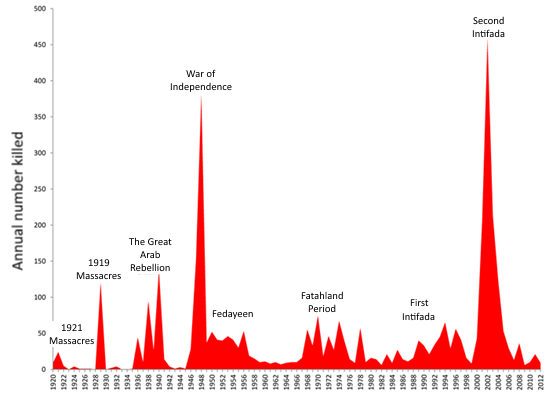
Distribution of those murdered during the British Mandate and in Israel,
in Arab terror attacks by years (1920-2012)[98]
A comparison between the 17 years preceding the Oslo process and the 19 years after its inception indicates that from 1977 to 1993, 357 Israelis were murdered in terror attacks, and from 1994 to 2012, 1,159 were murdered. In other words, the Oslo Accords not only failed to bring peace, but also tripled in the number of terror victims[99]. The peak year was 2002, in which 452 people were murdered, and the peak month was March 2002, when 131 Israelis were killed in 12 suicide attacks and in other attacks almost every day[100].
The lives of those murdered have no price, and it pains us to calculate the cost in this section. But in the end, the value of the work of those murdered is also part of the economic cost we paid, apart from the heavy emotional toll.
The per capita GDP in Israel is NIS 129,400[101]. The victims were of all ages, and therefore, according to the "half career" that the average casualty "managed to have" before he was murdered, that is 22 years of work, this is a loss of NIS 2,846,800 in income alone for each murdered person. Even without referring to the broken families, the orphans, the hundreds of children who were already born to the young victims, and the future income from them, which we did not take into account, this is a direct loss in terms of income only, of NIS 4 billion.
The loss during a person's life must be added to the damage caused by terror fatalities. The following table[102] shows that from 1977 to 1993, 914 people were recognized as victims of enemy action, and from then until 2012, 18,831 people were recognized as being injured by hostile actions. In other words, on a multi-year average, the number of wounded increased by a factor of 18 during the Oslo years.
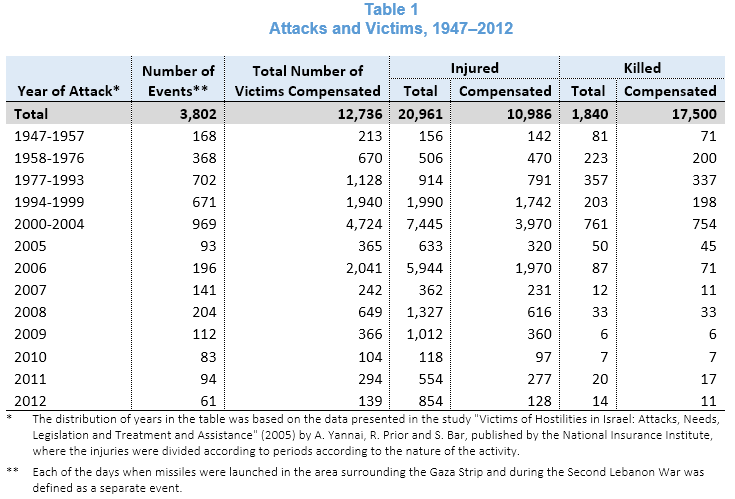
Total national insurance payments to victims of hostilities during the Oslo years was NIS 5.25 billion, which is NIS 8 billion, adjusted for inflation. This amount does not include the loss of working days of the victims and their families and the medical treatment of the injured, which for many was prolonged and expensive.
The total cost of this item is at least NIS 12 billion.
[88] The Open Budget – Ministry of Public Security Budget
[90] Statistics from the Ministry of Internal Security in answer to a query.
[92] Calcalist, 8 January 2014
[93] MyPi 24 December 2012 – Yanir Levin Consulting and Intelligence
[94] Calcalist 8 January 2014
[95] The Marker 13 September 2004
[96] Globes 29 October 2003
[97] Wikipedia – The separation fence.
[98] Wikipedia – Palestinian terror.
[99] Processed from the National Insurance Institute data in the table below.
[100] Processed from: http://www.jewishvirtuallibrary.org/jsource/Peace/osloterr.html
[101] In 2013
[102] National Insurance Institute – Annual Report 2012 Page 202
| << Prev || עברית || Français || Русский || Next >> |